During the last 3 years at the Teaching courses I have been asked to offer advice on the technical direction in the UKA.
After consideration I have set out below my personal thoughts on ‘technical direction’ and also the future direction of the UKA.
Clearly there is a difference between an individual’s personal technical direction and that of the technical direction of an organisation which endeavours to set out certain principles and disciplines while encompassing and harnessing the different understanding of aikido held by its senior teachers.
From its inception the UKA has not dictated a rigid form, allowing senior teachers to express their own understanding of aikido, those who have visited Hombu will have experienced the diverse application of a common thread and how this works in practice. Nevertheless its important to offer thoughts on how the UKA can navigate this delicate individual balance.
Personal TD and the understanding and the practice of aikido is governed by many factors including character, environment, history, teachers, physical makeup and age.
For background I have been mainly influenced by 3 teachers in my career. William Smith with whom I began my journey. I was his student/assistant for 35 years, given his background his aikido was focused on the practical values of aikido. In the late 60’s we began our journey with Chiba sensei, who was to become my teacher for 25 years. Later and to a lesser degree Kobayashi sensei, whose flowing movements fascinated me. Clearly I have also been influenced by Doshu and the various teachers on my 9 trips to Hombu and the study of visiting teachers to the UKA.
Chiba sensei’s aikido was clearly focused on the sword and the uncompromising martial elements. I make no apology for continually referencing his teaching advice (in italics). Most UKA teachers have had access to visiting teachers including Seki, Kobayashi, Sugawara, Masuda, Tamura, Yamada, Hino and Katsurada senseis and some have had experience at Hombu dojo, from these influences they will have determined their own technical direction. But few have experienced pre 1986 Chiba sensei aikido instruction on which a great deal of aikido in the UK is based and which I feel duty bound to pass onto UKA teachers…whether this is taken up or not is a personal choice.
In my opinion the decline in interest in world aikido in part due to the ‘bad rap’ it gets from the internet, where the focus is either on the ‘grab and smash’ or the ‘touch and fall’. During a lecture in 1990 Chiba sensei spoke of Doshu’s aikido having ‘no colour’ therefore accessible and identifiable to many diverse interpretations. Even then he explained the extremes, from solely practical through to abstract, with both extremes failing to understand aikido in its true form. To simply use the techniques of aikido as tools to effect an impact of your partner to the mat is missing out a good deal of what aikido is about. To understand that aikido has no other function that that of self-defence puts it in the sphere of MMA, Ju jitsu ect. in which it doesn’t fair well
At the other end of the scale are the ‘touch and fall’ practitioners who see aikido as having no more practical value than Yoga. No criticism on either point of view here……just not in my opinion either views are where the UKA should be positioned.
The middle ground is occupied by, amongst others, members of the JAC specifically UKA BB BA BAF all of who have a direct and physical, not just digital and commercial, connection with Hombu dojo and all had a foundation of Chiba sensei understanding of aikido..
To return to the original question of TD, I see this in 4 elements.
Weapons
Thanks to the expertise of McCalla sensei the UKA has undertaken a greater focus on the weapons work of Saito and Chiba sensei and the understanding of how that influences the empty hand body art. When Chiba sensei returned to teach in the UKA in 1986 he had begun developing his own weapons system which went on to become the genius of Sansho. But from the late 60s the foundation of his aikido was based on the using the bokken in particular. A days training could consist of 3000 1st suburi. For me the ‘translation’ of Bokken and Jo training into body art is vital, unappreciated and misunderstood. Clearly the first suburi with bokken and Hachi no ji geashi with Jo form the basis for many aikido body movements. The fundamental Hamni posture with or without a bokken should be a default posture intrinsic in the execution of many technique, this will naturally create the alignment of feet, hands, elbows, hips. Focus on the little finger in gripping and cutting. Relaxed shoulders, 60/40 weight distribution…. these are just basic starting points. Distance, timing and awareness are skills fundamental to weapons training as they are to body art.
Tori’s Posture and focus.
All of the above plus… Consciousness of the centre of gravity both for Tori (maintain centre over base) and Uke (disrupt centre over base Kuzushi). Awareness of partners’ possible continued intentions not just on the first grip or strike, lessons understood in weapons Awase but generally ignored in open hand practice. Close down any position or opportunity for the Uke to respond or continue with the contact. Understanding attachment and non-attachment, distance prior to the point of contact (mai). Utilise flexible (soft) first contact. Breathing …when to inhale/exhale. Focus of energy should emanate from the centre (around the level of the navel), strength and tension in the shoulders restricts the flexibility of the hips and the arms, inhibits the flow of energy and raises the centre of gravity. Strong ‘impact responce’ in gripping or striking can give the Uke a fixed point in which to regain balance and direction and then at that point strength becomes a factor.
Ukemi.
Forward, backward, sideward, 32 direction. The essence of ukemi is recovery.
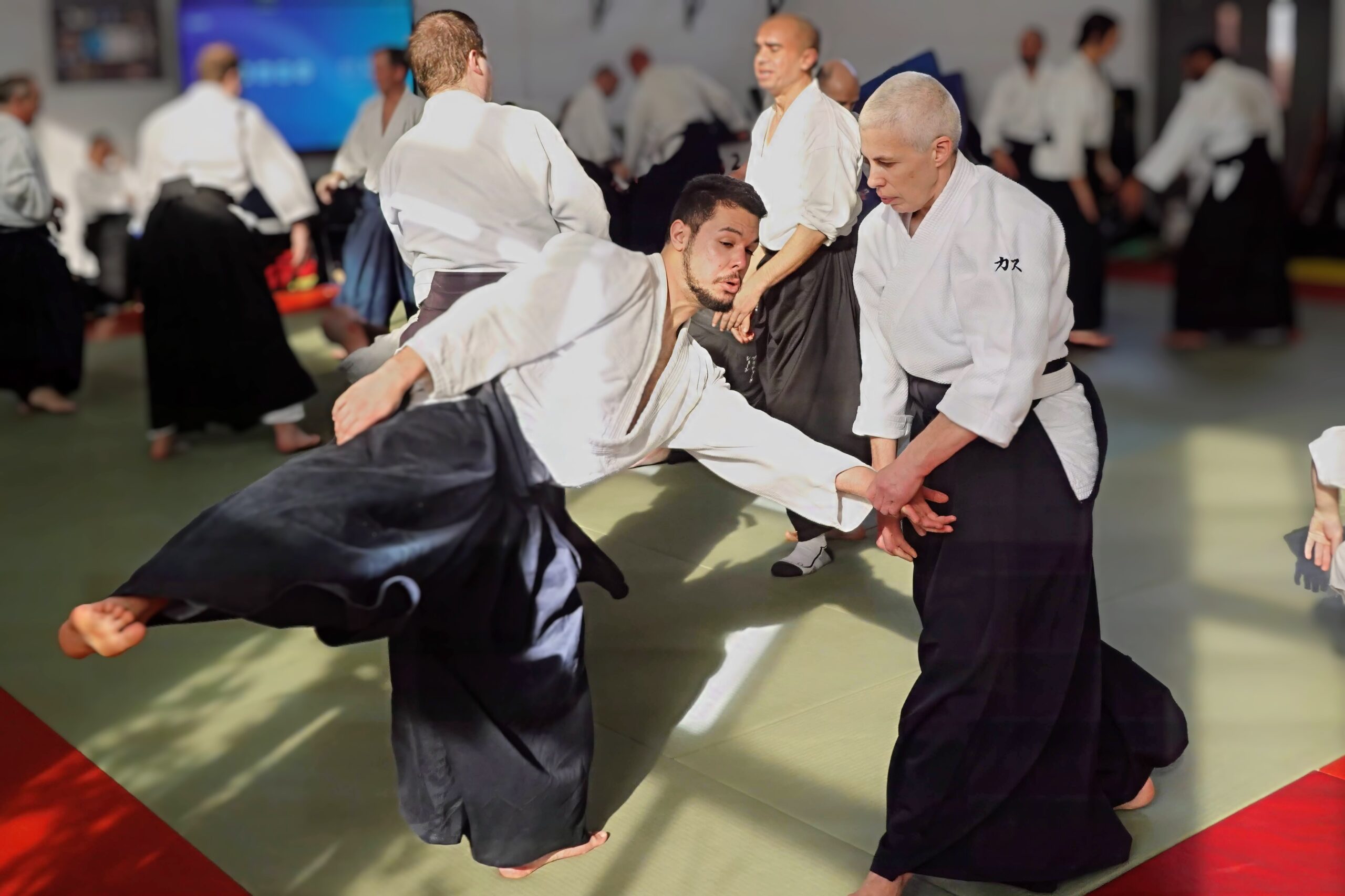
At the perceived point of contact, either striking or holding, Uke posture will be naturally stable, as Tori moves Uke, whether its 150mm or a metre, Uke’s instinct will be to move to correct the loss of balance (kuzushi). (Recovery… A natural response we all perform a thousand times a day) If a step is required by Uke (eg.In ushiro waza) then this should be generated by the centre of the body as a positive move (not ‘fairy steps’ head down bum out!). When movement, stretching or counterbalancing can no longer achieve stability then ukemi is taken, not as a surrender or collapse but as an active movement and response to regain posture, balance and equilibrium Do not anticipate, predetermineor pre-empt where or how Tori’s movement will unfold. Simply just go where you are put. Don’t fall away, maintain physical contact as long as possible but maintain ‘awareness contact’ till engagement is complete (Zanshin). The path to develop this connective and cohesive ukemi comes with much training and experience……while in the early stages of practice ukemi can be seen as artificial and choreographed, as practice develops and intensifies ukemi is the invaluable skill to avoid injury.
Effectiveness
95% of aikido is exercise technique only 5% practical application. Iaido and karate use imaginary bodies to practice and develop their art, in aikido we have the benefit of using ‘mostly’ live bodies! The foundation of aikido is movement, spherical, linear, circular and spiral. Bolted on and as a consequence of these movements, techniques are applied. Understanding of method/process will develop effective techniques, the reverse will not. The techniques are tools by which we learn how to do aikido. These body movements, tight or expansive are the training ground/drills/exercise that develop the aikido skills we are looking to achieve. These movements, while retaining the core principles, can and should be condensed into a practical application which can be delivered with power and energy that is out of proportion to the physical strength of Tori.
Students who use forceful physical strength should practice more exercise technique, those who are less physical and assertive should do more practical work (paraphrased)
An exercise technique for example… gkayu hanmi tenkan uchi kaitenage ura requires 5 rotational /spherical movements from Tori in which, from the first point of contact, Uke attempts (and should fail) to regain balance, resulting in ukemi.Understanding and developing this ‘process’ will develop the ability to execute related practical techniques such as chudan tsuki uchi kaiten sankyo.
Teaching observations and evolving progression.
For me teaching aikido has 6 elements……inspire without ‘showboating’, teaching with respect, mentor and support, learning from the students, confidence while still being critical of one’s own ability. Engage with students not just observers.
Additionally to this I would refer to Cath Davies excellent book SHU HA RI (recommended reading for all teachers) in which Cath details the 3 levels of understanding of Aikido from a student and teacher perspective. In the context of these comments on teaching I will simplify this to 3 levels of instruction
Technique, ikkyo, shihonage ect…
Movements that develop the principles of techniques…….
Concepts that determine individual pathways…the big picture.
.
A few quotes to support this opinion.
Ultimately you must forget about techniques. The further you progress the fewer teachings are there. (Art of Peace M.Ueshiba}
Every encounter is unique and the appropriate response should emerge naturally (Art of Peace M. Ueshiba)
Empty your cup before each training. Start with a beginners mind (M. Kanetsuka )
The instruction (of that technique) was yesterday, this is today. K.Chiba
Aikido is not a rigid form, at every level it is changing and evolving. The aikido of each generation whether within the Ueshiba family, Hombu dojo or here in the UKA, undergoes change. Clearly age plays a big part in the changing understanding of aikido. Personally my decline in physical strength has opened up a new direction which I have found challenging and rewarding.
In the dojo each contact whether striking or gripping is never the same, distance, strength, posture even the emotional state of Tori and Uke plays a part. It follows therefore that every technique is different. To teach by just repeating the same movements because it’s comfortable and it ‘works’ but expecting improved results leads to complacency and overconfidence. Be self-critical, study the elements that make up your aikido, posture, effectiveness, flexibility. Focus on the weaknesses not the strengths. On each class set out to learn or observe some detail. The highest grade can learn from beginners whose responses can be awkward, natural and unschooled.
Future Direction of the UKA
Firstly we need to recognise that the UKA holds an enviable and priceless relationship with Hombu dojo and Aikikai, achieved through many years of commitment and careful steps, it’s a position that I feel is not fully appreciated by many UKA members. The UKA was the 1st to achieve many of the (Hombu) benefits that we often take for granted.
For the last 20 years our collective influences have been overlaid by instruction from Kobayashi, Sugawara, Seki, Hino and Katsurada sensei. As an organisation we have listened and learnt from these very different teachers, thereby connecting the UKA with Hombu teaching direction. Added to that the openness, flexibility and acceptance of the differences that clearly exist between the senior teachers of the UKA have put us in the forefront of Aikikai organisations in the UK. A position I am confident is appreciated in Hombu.
The landscape of aikido in the UK is littered with failed or failing groups, generally led by one individual (do it my way!), who don’t see the relevance of striving for an active (not commercial) relationship with Hombu. It is vital that as aikido teachers we are inspired by, but also answerable to a higher authority, ultimately Doshu and not drawn into the idea that any of us are beyond further instruction.
I am doing what my teacher did I don’t want anything else….. I have been practicing for ## years I know aikido……we are as good as Japanese teachers…Hombu is no longer relevant. Are phases that we have heard over the years.
I see the UKA as a lake, deep and well established, constantly reenergised by fresh water, not a stagnant pond devoid of creative input.
The structure of the UKA is solid and fit for the next 20 years, the personnel will change but if the policies now in place remain, along with the strong relationship with each other and with Hombu the future is secure and we, as caretakers of William Smiths vision, can say we have done a good job!
Kuzushi, sankaku, shihogiri, Happogiri.
Kuzushi is common to many martial arts and refers to ‘breaking your partners balance’
Sankaku. In years past there was a focus of the teaching and explanation of Sankaku, the triangular principle and how it applies to aikido, it’s a useful approach worth exploring, and is present in our basic posture and the positioning of Tori’s ‘line’ in most practice.
If we view this in geometrical terms…. use the line of the partner’s feet as the centre line and draw a perpendicular line midway, then an equilateral triangle either side, then this gives the imaginary point in which the partner will momentarily loose balance. These 4 directions clearly create Shihogiri, Shihonage/Kokuho and are present in Chiba sensei’s suburi.
If we divide these 4 quadrants it gives us 8 directions, techniques such as shomen uchi ikkyo and shihonage to the open side and kote geashi and iriminage to the closed side are examples.
Happo giri with the bokken or open hand clearly defines these directions and will develop the ability to keep a centred posture while moving and being able to quickly change focus… that’s useful in multiple attack training. This 8 direction also formed Chiba sensei extended forward ukemi from the 70s. Right foot and right hand, left foot left hand, right foot left hand, left foot right hand. 32 in total.
Shihogiri and Happogiri emphasize the importance of the cutting movement of the sword/bokken and how it is adapted to the open hand practice. Generally cutting up movement is used when moving off line towards Uke and equally as important, cutting down when moving off line away from Uke.
I hope these random thoughts are of interest.
Gordon Jones